
This is the main option to start writing content. By defining a keyword and a title, you provide the tool with the basic information it needs to write quality content of the length you want.
By providing a brief, you can define even more clearly and specifically what you want the content to be about. Here you can indicate the angle, the individual topics to be covered or avoided, and which topics to explore in depth or not.
It is the best SEO solution for obtaining quality content that complies with the fundamental EEAT principles and is actually useful for users. Specifically, it works as follows:
in-depth SEO analysis of the topic
analysis of competitors in SERP
RAG analysis to reduce classic AI hallucinations to less than 0.5%
definition of topics to be covered from an SEO perspective
definition of topics to be covered based on title, brief and usefulness to the reader
evaluation of how to write the article in order to comply with Google's Experience, Expertise, Authoritativeness and Trustworthiness (EEAT)
principles definition of an article structure with H2 and any H3 and H4, based on the length requested by the user
writing of the article
STEP 1: CREATE CONTENT FROM KEYWORD
Click on ‘Create content from keywords’.

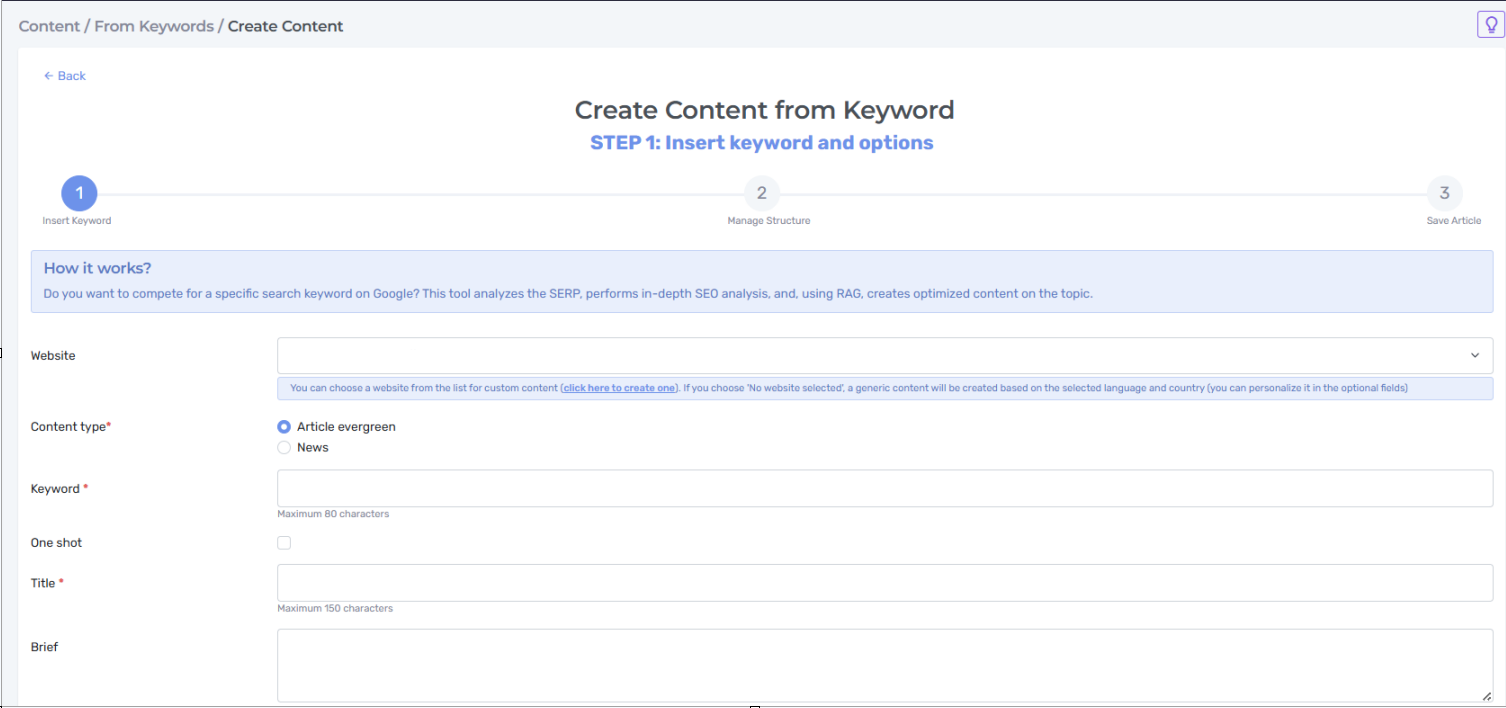

Select the website you want to work on. In ‘Site’ if no site is present, you must first enter one in Settings > Sites.
In ‘Content type’, select the type of content you want from the available options: evergreen article or news . This selection will determine the structure and editorial approach of the final text. Specifically, for news, the tool will only work on topics from the last few days, while for evergreen articles, it will work on topics from the last year.
In the Keyword’ box, enter the main keyword or keywords for SEO optimization of the content. It is important to respect the maximum limit of 80 characters to ensure effective indexing, however, the system allows you to use longer keywords.
By ticking the “One Shot” option, you ask the tool to perform all the analysis and generate the structure and content independently. Therefore, once you have confirmed your entry on this page, you simply need to wait for the article or news item to be finalized. If this option is not selected, the system will perform a complete analysis and propose an H1, H2, H3 structure for the content, which you can modify as you wish.
Use the ‘Brief’ field to provide the tool with any specific instructions on how the content should be written, which topics to cover and explore in depth, etc. If no brief is provided, the tool will use an in-depth SEO analysis to decide independently how to structure the content in order to best compete with competitors on the same topic.
In the ‘Image’ field, you can request 1 to 4 cover images for the content. You can provide further details in the optional fields. You can also generate other images after the content has been created. We therefore suggest that you initially indicate the value 1 if an image is required.
Once all the configurations have been completed, click on the “Start project” button to begin the processing. The tool will first perform an in-depth SEO and semantic analysis. If the “One Shot” option has not been selected, it will then propose an optimized structure for the content. If “One Shot” has been selected, it will provide the final content within a few minutes.
OPTIONAL FIELDS
Clicking on ‘Optional Fields’ a form will appear, where you can define the characteristics of the content you want to obtain in more detail.
This data is automatically filled in based on the settings indicated in ‘Settings’

> ‘Sites’ > ‘Site Name’ > “Settings” > ‘Default Values’, but it can be customized for each request.
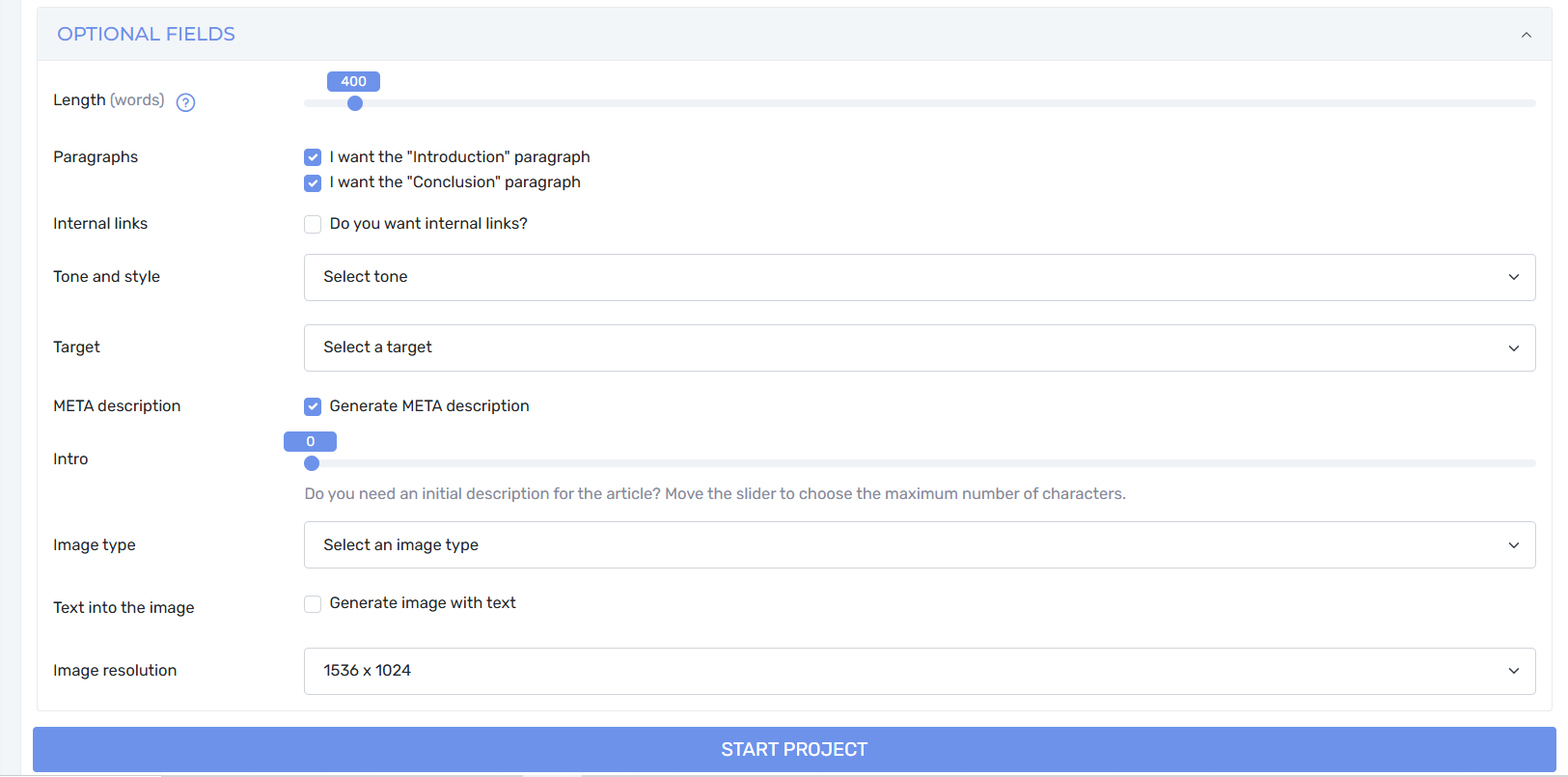
In ‘Length’, you can specify the desired length for the final content by selecting the number of words. Important note: content exceeding 2,800 words is subject to a different rate (more details are provided during the selection process).
In ‘Paragraphs’, you can indicate whether you want the content to include a paragraph dedicated to the “Introduction” and one dedicated to the ‘Conclusion’.
‘Internal links’: tick this box to enable the automatic insertion of links to other pages on your website. The tool will automatically insert links to relevant pages already on your site when it detects related topics in the text.
In ‘Tone and Style’, you can use the drop-down menu to select the most appropriate tone of communication and writing style (formal, informal, technical, informative, etc.). Here you can also select any custom tones and styles created in the “Settings” > ‘Sites’ area.
In ‘Target audience’, you can specify the target audience for the content in order to optimize the language and communication approach. If there is no target audience, you must first enter one in Settings > Sites.
If necessary for SEO optimization: activate the flag for automatic generation of the ‘Meta description’.
If an introducion on of the content is required, use the slider in ‘Intro’ to indicate the length of this description in number of characters.
You can define the type of image to be generated, choosing between standard image and high-quality image. What is the difference?
Standard image (recommended without text): the images are generally of good quality, but there may be slight errors, such as some small parts of objects or people missing. Not recommended for use if you want text.
High quality (with text): excellent quality images, even photographic, free of errors and where it is also possible to display long texts.
If you want to insert an ‘Image with text’, select the appropriate box and specify the text you want to add.
Select the ‘Image resolution’ from the menu: 1024x1024 (square), 1536x1024 (horizontal), 1024x1536 (vertical).
After completing both the mandatory and optional fields, click on the “Start project” button to begin the processing.
You can wait or exit the page. If you exit, you can view the content writing status under ‘Content’ > ‘Content from keyword’. To understand the meaning of the various content generation statuses, refer to the legend at the bottom of this document*.
STEP 2: STRUCTURE MANAGEMENT
If you have not selected ‘One shot’, once the tool has performed the various analyses, it will allow you to manage the H2, H3, H4 structure of the content before writing.
On the right, you will find a box called ‘Elements to add’ containing the H1, H2, and H3 used by competitors who are at the top of the SERP for the topic you are working on. Simply drag them to the left.
An optimized structure will be proposed, which you can modify in various ways:
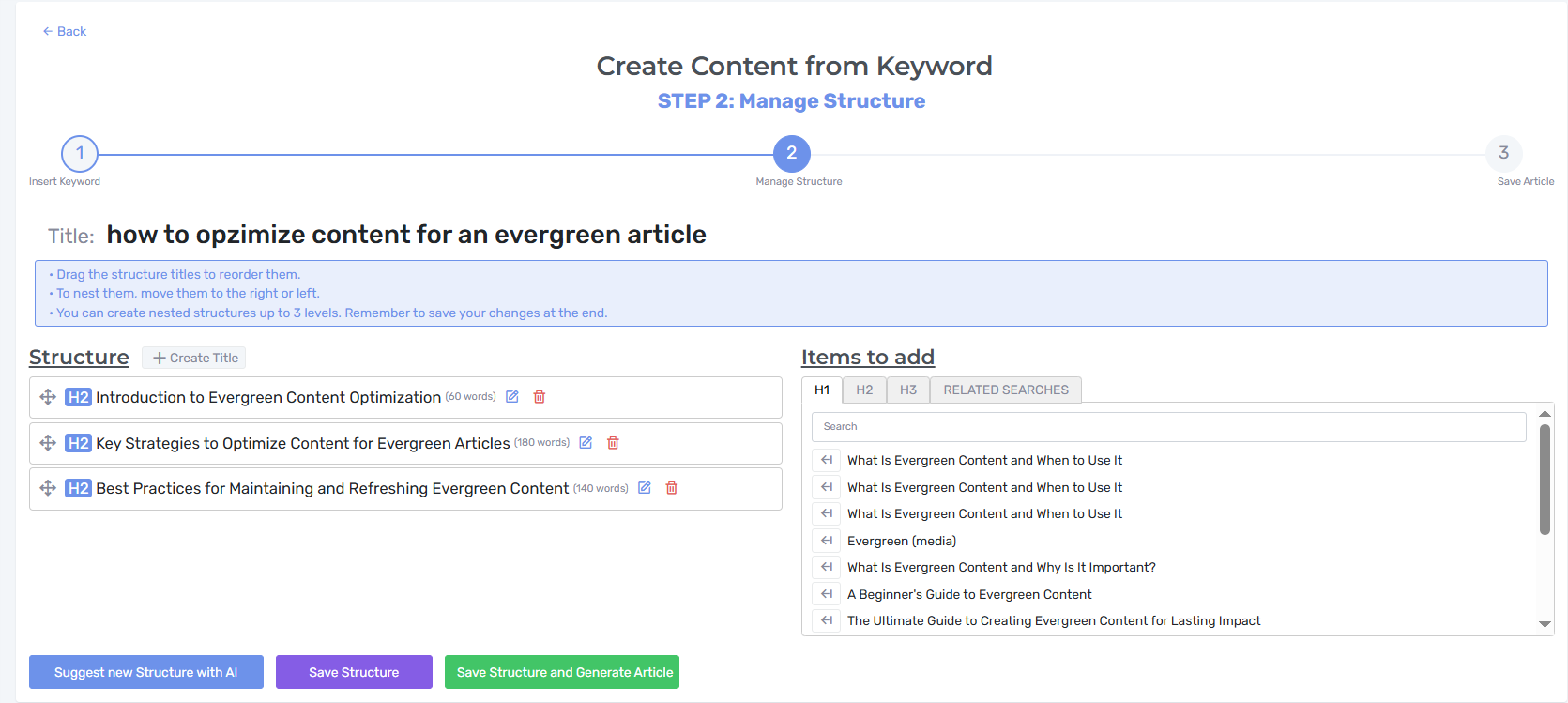
Changing the title or creating a new one: click on the pencil icon to change the title of the paragraph.
Text length of an H1, H2, H2 title: specify the desired number of words. Drag and drop: drag the H1, H2, H3 titles suggested by the tool using the icon.
Deleting: delete unwanted content using the appropriate icon.
Change title order using drag and drop Click on the icon next to the title box, drag the box to the new position and release to confirm (e.g. an H2 title dragged into another H2 → becomes H3, used to create subsections. An H3 title moved as an independent element → becomes H2.
You can also ask the tool to generate a new structure “Suggest new structure with AI”, or you can save the current structure “Save structure” and then resume it later (also useful if you want to evaluate the structure generated with another author) or save the structure and generate the content at the same time “Save structure and generate article”.
STEP 3: CONTENT SAVING
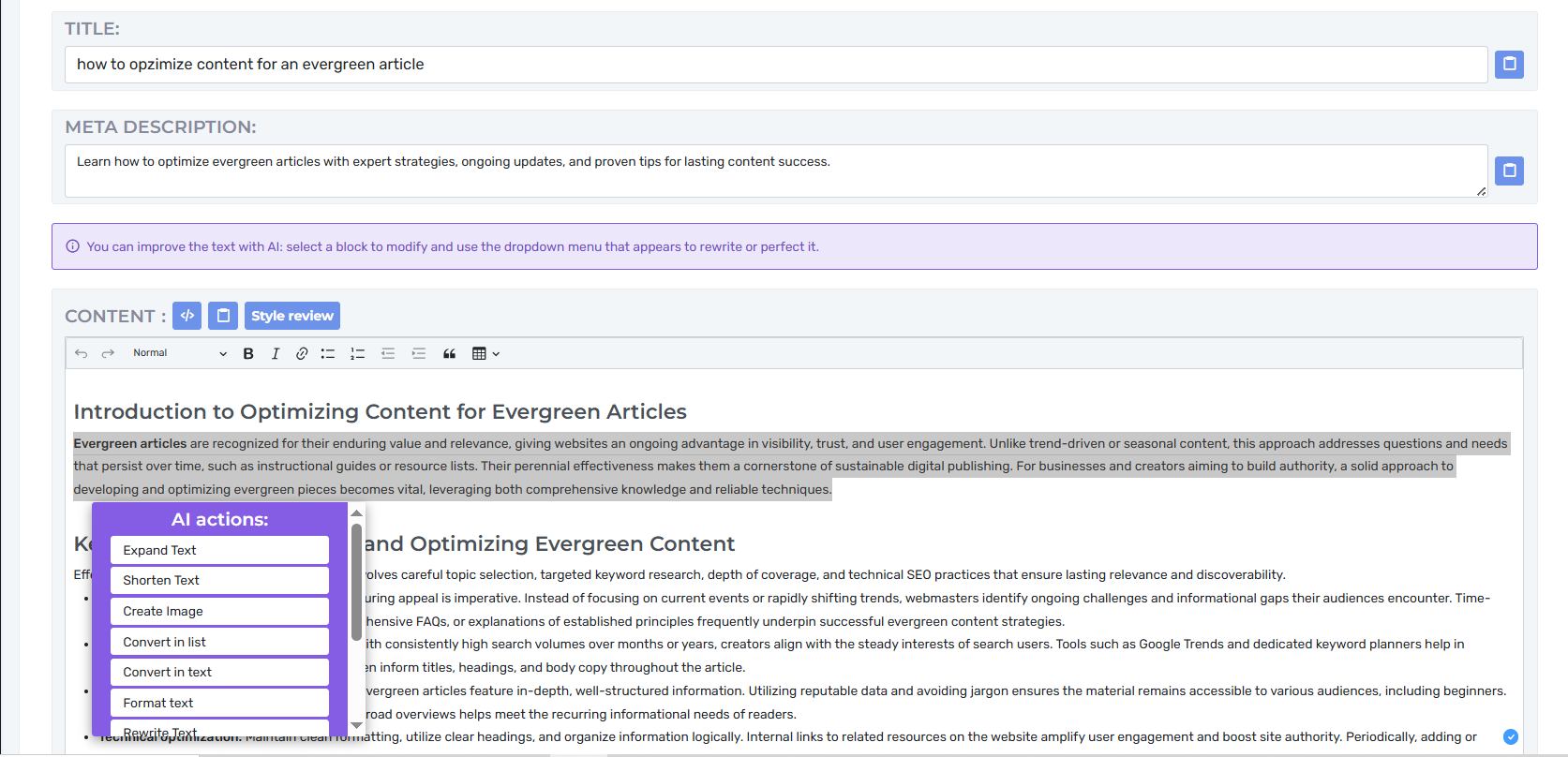

Once the project has reached the ‘Article ready’ status, the system makes the complete content available for final review and changes. The tool shows the final result in its entirety, allowing all the required elements to be viewed:
Meta description: the description optimized for search engines (if requested in the configuration).
Introduction: the opening paragraph introducing the topic (if selected in the optional parameters).
Main text: the body of the content complete with formatting.
By clicking on the icon

, you can view the content in HTML.
Use the appropriate icon

to automatically select all the text content. Once selected, you can quickly copy the entire content, transfer the text to other documents or platforms, and share the material without having to select it manually.
The ‘Content’ section contains the generated text and offers advanced features for refining the text through direct interaction with the tool. You can make corrections manually or via the drop-down menu, asking the tool to intervene to improve:
Expand: expands the content by adding details, examples or insights
Reduce: shortens the text while retaining essential information
Create Image: generates images related to the text content
Convert to list: transforms the text into a bulleted or numbered list format
Convert to text: converts lists or other formats into text
Format text: applies formatting styles (bold, italics, headings, etc.)
Rewrite text: completely rephrase the content while retaining the meaning
Simplify text: make the text more accessible and understandable
Translate: convert the text into other available languages
Ask AI: allow you to enter instructions for AI for a specific request, describing the changes to be made to a selected text
Create Table: organize information in tabular format
Once you have completed the creation process, you can save by clicking on ‘Save content’.
If you need to review the structure of the article, you can restart the creation process by clicking on ‘Back to step 2 - generate structure’.
Request for data entered: here you can see all the data initially requested during the entry phase.
IMAGES

The image generated by the tool can be enlarged for easier viewing. You can also copy the direct URL to upload it to your CMS. Please note that images will remain available on the server for 7 days, so you cannot link directly to the image; you must save it to your computer or upload it immediately to your CMS. If the generated images do not fully meet your aesthetic or functional expectations, you can click on the “Edit” button to enter new instructions to modify them by filling in the following fields:
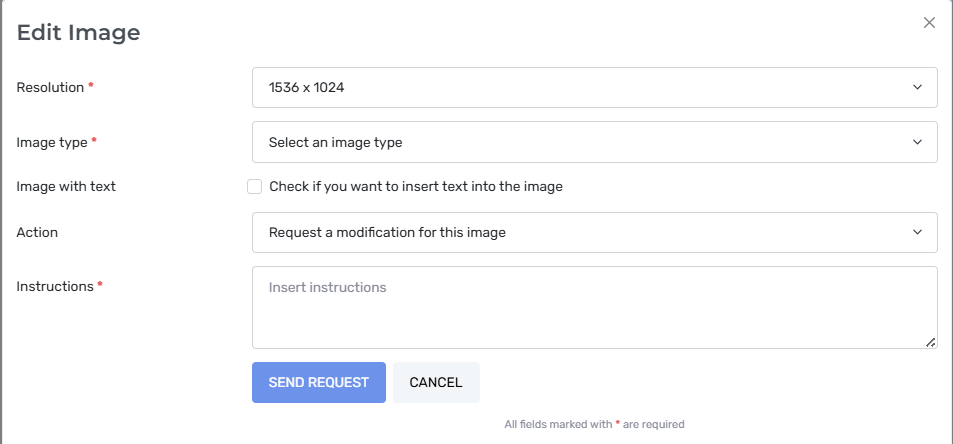
In ‘Resolution’, select from the menu 1024x1024 (square), 1536x1024 (horizontal) or 1024x1536 (vertical).
In ‘Image Type’, select Standard Image (recommended without text) or High Quality (with text).
If you wish to include text in the image, tick the ‘Image with text’ box and enter the words you want to add in the text field that appears. The tool will automatically integrate the text into the generated image.
In ‘Action’, you can ask the tool to regenerate a new image from scratch or make changes to the existing image.
In ‘Instructions,’ enter a detailed description of the image you want to generate. The more precise and specific are the instructions, the better the final result will be.
LIST OF CONTENT CREATED
Once you have submitted your request for content generation, you can monitor its status on the Content > By Search Keyword homepage. Here you will find all content that has already been created or is currently being created.
FILTERS

To search for content that has already been entered, you can filter by:
author: selecting the author who entered the content
website: selecting the website for which the content has been written
keyword: entering any word from the content title
*Content processing status legend:
The system monitors each piece of content through different statuses that indicate the current processing stage.
Waiting to start: the content is queued for processing. No action is required.
Keyword without sources: the keywords did not produce sufficient results. Action required: modify the search keywords.
Analysis in progress: the system is analysing the available sources and gathering information.
Keyword and topic analysis complete: the analysis is complete. The system has gathered sufficient information to proceed.
Structure to be managed: the content structure is ready for review. Action required: approve or modify the proposed structure.
Structure creation in progress: the system is processing the final content structure.
Queued for writing: the content is scheduled for writing but is awaiting available resources. Writing in progress: active drafting of the text according to the defined structure.
Final optimisation: the text is complete and the system is performing final optimisations.
Stylistic review: linguistic refinement and consistency check of the text.
Article ready: the content is complete and ready for publication.
No results: the system was unable to produce satisfactory content. Action required: review the search parameters.
** Images generated by AuthorEvo are produced using the most advanced artificial intelligence models trained on large multimodal datasets. While using state-of-the-art algorithms to ensure visual consistency and quality, the probabilistic nature of AI systems means that results may sometimes contain imperfections, anomalies or content that does not perfectly match the requested specifications. Users are therefore advised to consider the images as generative outputs to be validated and, if necessary, refined or post-produced according to the context of end use.